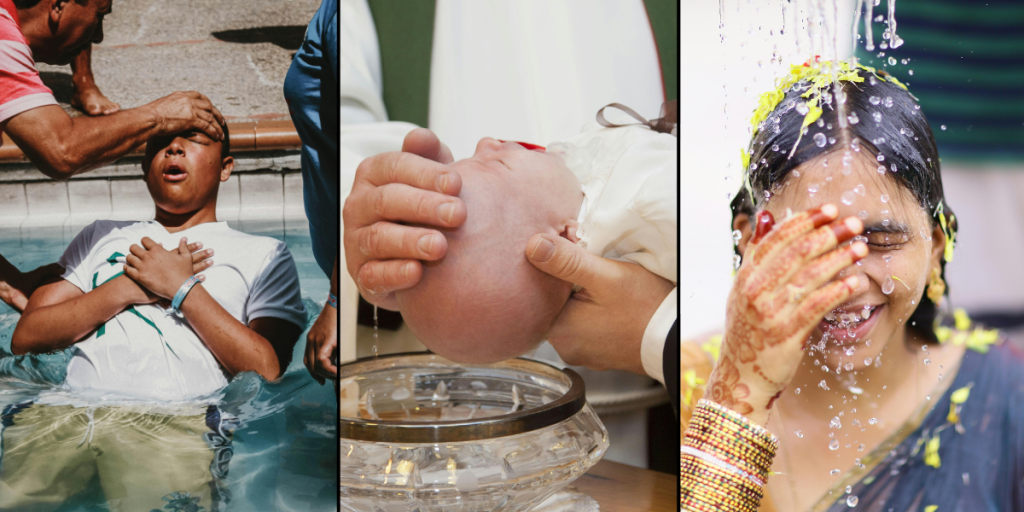
Ask most Christians and they will tell you that baptism is an important aspect of Christian life. Christ himself commanded the disciples to “go therefore and make disciples of all nations, baptizing them in the name of the Father and of the Son and of the Holy Spirit.” (Matthew 28:19, ESV). However, if you ask those same Christians how baptism is supposed to be performed, you may be surprised to hear differing answers. In general there are three modes of baptism: dunking/immersion, pouring, and sprinkling. Each of the three modes uses water as a means of symbolizing the washing away of sin and the beginning of new life in Christ. But does the method of baptism matter? Not particularly, at least not according to the historical record. Jesus never gives specific instructions as to how to baptize aside from in the name of the Father and of the Son and of the Holy Spirit. That said, let’s look at the first mode: immersion.
Baptism by immersion is fairly straightforward. Usually the pastor or officiant gives a short speech concerning the importance of baptism, asks the one being baptized if they understand the role of baptism in their life, and then baptizes them in the name of the Father, Son, and Holy Spirit. The practice of baptism by immersion dates back to the earliest days of Christendom. The practice is based on the more ancient practice of ritual bathing. As for it becoming a Christian practice, it is based on the account of Christ’s own baptism: “In those days Jesus came from Nazareth of Galilee and was baptized by John in the Jordan. And when he came up out of the water, immediately he saw the heavens being torn open and the Spirit descending on him like a dove.” (Mark 1:9–10, ESV) The word “baptize” here is based on the Greek term “baptizó” meaning to immerse or submerge. So, the early church and early church fathers followed the example laid out by Christ, and it was that way up until the 10th century. Prior to that, baptisms by pouring or sprinkling were reserved only for the imprisoned and the dying.
Baptism by pouring is also an ancient practice, though not so ancient as ritual bathing. This mode of baptism originated in the early church, somewhere around 50–120 AD. This date is certain because of an early Christian document called “The Didache” or “The Lord’s Teaching Through the Twelve Apostles to the Nations.” This document contains some very early Christian teachings which Saint Athanasius said were “appointed by the Fathers to be read by those who newly join us, and who wish for instruction in the word of goodness.” The Didache mentions the preferred method of baptism being immersion but makes an allowance: “And concerning baptism, baptize this way: baptize into the name of the Father, and of the Son, and of the Holy Spirit, in living water. But if you have no living water, baptize into other water… But if you have neither, pour out water three times upon the head into the name of Father and Son and Holy Spirit.” (Didache 7:1–5) By the 10th century, baptism by pouring had become increasingly popular.
Baptism by sprinkling is less common than the other two modes. This mode is a little harder to pin down historically speaking. It also appears to be a practice of the early church, albeit a very uncommon one. This mode was usually practiced when the recipient was on their deathbed. That said, it is also a practice rooted in the Scriptures. Ezekiel 36:25 says, “I will sprinkle clean water on you, and you shall be clean from all your uncleannesses, and from all your idols I will cleanse you.” And Numbers 8:6–7 says, “Take the Levites from among the people of Israel and cleanse them. Thus you shall do to them to cleanse them: sprinkle the water of purification upon them…” But this practice has long been a contended one. That said, the early church father Cyprian of Carthage said this in response to a spiritual son of his asking about baptism by sprinkling: “It appears that the sprinkling also of water prevails equally with the washing of salvation; and that when this is done in the Church, where the faith both of receiver and giver is sound, all things hold.”
There is one other type of baptism that I’d like to mention: the baptism of desire. This mode of baptism takes a litany of forms, and it’s because this mode is a response to two things: a lack of water and an urgency/great desire for baptism. This mode of baptism should be understood as a means of baptism for those who, through no fault of their own, cannot receive the sacrament physically. If a person is on their deathbed and cannot receive baptism in any physical form but expresses the desire for it, this is considered a baptism of desire. If a person has a disability or physical condition that makes physical baptism impossible but expresses a desire to be baptized, this should be considered a baptism of desire. If a person lives in a climate and environment in which water is a precious necessity and cannot be spared but they express a desire to be baptized, this, too, is a baptism of desire. These are just three examples of this mode of baptism, and it can be a hard concept to explain theologically, but it is a mode of baptism nonetheless.
No matter what method of baptism is observed, it should be respected and honored as we are all baptized into one body. We can argue day and night—and the Church has—about the proper method of baptism, but in the end, is the method of baptism a salvation issue? Would you deny the baptism of the believer from Aoulef, Algeria which receives less than an inch of rain annually? Or the baptism of the Christian from the Sudan which receives less than a tenth of an inch of rain annually? I reiterate what St. Cyprian said, “where the faith both of receiver and giver is sound, all things hold.” I’ll leave you with one more quote from St. Cyprian; he said this concerning baptism, “I think that the divine benefits can in no respect be mutilated and weakened.”
 T. Allen Burr Ministries
Leave a comment