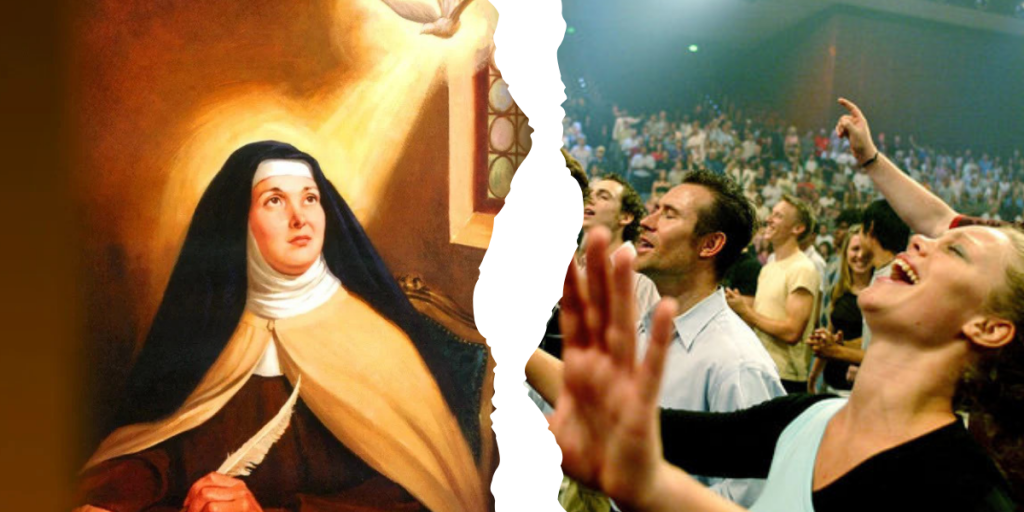
I grew up in a charismatic Christian denomination – the Assemblies of God, to be specific. I know what it is to be a charismatic Christian. In addition to this, I have a Masters in Philosophy & Apologetics and my thesis dealt with a primary teaching based in Christian mysticism. Why do I tell you this? As I was studying Christian mysticism, I noticed that there seem to be a great deal of overlap between these two ideologies. That’s what I will endeavor to cover here, today.
Christian Mysticism
When most see the word “mysticism,” notions of the esoteric and arcane generally creep into their minds. Mysticism, to the uninitiated (bit of a joke here as the Greek base word for “mystery”, μυέω/mueó, carries the connotation meaning “to initiate, to instruct, to learn the secret”), seems like some kind of unchristian hocus pocus at first blush, however, when given proper instruction, it loses that preternatural quality. So what is mysticism in the Christian sense?
It may be best to start with some etymology. As I mentioned, the term we use for mystery in regard to Christian mysticism is the Greek word mueó which, as I said, bears these connotations: to initiate, to instruct, to learn the secret. Strong’s Concordance states that it means “shutting the eyes and mouth to experience mystery.” Mysticism is part a wider religious experience in which an adherent attempts to achieve a non-sensory, extrovertive union with a higher power. Put simply, mysticism is the attempt of a believer to unite with God in a deeper, more personal spiritual sense. Dr. Dennis D. Martin, in Walter A. Elwell’s Evangelical Dictionary of Theology, wrote the following definition about what mysticism is:
Christian mysticism seeks to describe experiential, direct, nonabstract, unmediated, loving knowledge of God, knowing or seeing so direct as to be called union with God.
– Dr. Dennis D. Martin
I appreciate Dr. Martin’s commentary on what mysticism is in Elwell’s book. He makes a very clear distinction that “mysticism is not the same as magic, clairvoyance, parapsychology, or occultism.” Christian mysticism is not any of these things nor is it syncretism (the blending of faiths or their elements). It is a distinct religious practice.
What Is Christian Mysticism?
Christian mysticism is characterized by several things: prayer, purification of ego, meditation, contemplation, the Sacraments, illumination of the mind and soul, and union with God. Christian mysticism lacks any definable theological boundaries and is found across Christendom; Catholic, Protestant, and Orthodox Christians all have their mystics. What then is the focus of a Christian mystic? Union with God.
The ultimate goal of the mystic is to be united with God in every aspect humanly attainable. A.W. Tozer, who many describe as a modern mystic, had this to say about mysticism:
A mystic is a believer who practices the presence of God.
– Rev. A.W. Tozer, The Presence of God
Mystics practice the presence of God this is achieved through the pillars I described a moment ago: prayer, purification of ego, meditation, contemplation, the Sacraments, and illumination of the mind and soul. The path toward union with God in the mystic sense begins with prayer. This isn’t run-of-the-mill, dinner-time prayer. This is soul travail – that deep, hard work of the soul coming to grips with the depths of its sinfulness and its desperate need for the mercy and grace of Christ. This compels the believer to work earnestly to purify themselves of ego. This is far more than simple adjustment of behavior but involves an attitude of total repentance.
This work naturally leads into mediation and contemplation. Now, these two pillars often blend into one another. Meditation is a deep thought exercise focusing on the things of God and the chasm that lay between us and His perfection and goodness. It is an exercise in trying to understand one’s own relationship with and to God. Contemplation deals more with a willing suspension of the mental faculties in order to bask in and appreciate the person of God and the relationship borne from Christ’s sacrifice on the cross. It is a quiet searching for a fuller awareness of God and His presence. John of the Cross described the difference between meditation and contemplation in his work Ascent of Mount Carmel saying:
The difference between these two conditions of the soul is like the difference between working, and enjoyment of the fruit of our work; between receiving a gift, and profiting by it; between the toil of travelling and the rest of our journey’s end.
– John of the Cross, Ascent of Mount Carmel
The Coptic Orthodox monk Matta El Meskeen had some additional thoughts:
Meditation is an activity of one’s spirit by reading or otherwise, while contemplation is a spontaneous activity of that spirit. In meditation, man’s imaginative and thinking power exert some effort. Contemplation then follows to relieve man of all effort. Contemplation is the soul’s inward vision and the heart’s simple repose in God.
– Matta El Meskeen, Orthodox Prayer Life: The Interior Way
These practices go hand-in-hand, but they are not the only meditative/contemplative aspects of the faith. These practices are amplified by the observance of the Sacraments. If you ask members of the different expressions of the faith how many Sacraments there are, you will get different answers, but most agree the Baptism and the Eucharist are instructed to be honored as Sacraments by Christ. In the observance of the Eucharist, there are differing understandings of how the presence of Christ works in those moments. In a future blog I’ll discuss these terms in greater detail, but the prevailing understandings of Christ’s presence at the Eucharist can best be described by the terms “transubstantiation,” “consubstantiation,” and “memorialism.”
The mystic views the observance of the Eucharist as a deeply holy and reverent time during which they can experience the presence of God. No matter which one of the above understandings a mystic subscribes to, the mystic would understand that Christ is truly present with them as they partake of the bread and fruit of the vine. These contemplative practices would undeniably bring the mystic closer to God as they do just as Christ said: “This do in remembrance of me.” As they remember Christ, they bring Him closer to themselves and take another step closer toward union with Him.
Lastly, comes the moment that the mystic longs for: the illumination of the mind and soul and union with God. Illumination is, in short, what it sounds like. It is the revelation of the dark parts of our souls. It is the work of the Holy Spirit in a believer’s life in which He holds up a true mirror of sorts that enables the believer to see their flaws and shortcomings. But the Spirit does not simply illuminate the believer’s soul, He also illuminates their mind. The believer is enabled by the power of the Holy Spirit to better grasp the nuances of the Word. Theologian R.C. Sproul Jr. has this to say about the doctrine of illumination:
Illumination can, indeed should work alongside the Spirit’s work of conviction. Here the Spirit not only helps us understand the text, but helps us understand ourselves.
– R.C. Sproul Jr., “What is the doctrine of illumination?“
And then, at last, the believer is united with God in all ways humanly possible. John of the Cross had these two things to say about this unity:
The soul that is attached to anything, however much good there may be in it, will not arrive at the liberty of Divine union.
– St. John of the Cross
True happiness comes from being content with God’s companionship alone, detached from all else, even in heaven itself.
– St. John of the Cross
Unity with God requires the believer to disconnect themselves from the world around them, to detach themselves from worldly things (yes, even our own families). This is what Jesus meant when He said: “If you want to be my disciple, you must, by comparison, hate everyone else—your father and mother, wife and children, brothers and sisters—yes, even your own life. Otherwise, you cannot be my disciple.“ The believer, and the mystic especially, must liberate themselves from earthly connections to attain a higher, divine union with God (For you Star Wars fans, think of it like the Jedi Code. The Jedi are taught to avoid love and growing attached to others; they are taught that compassion is the way of the Jedi.)
Unity with God is characterized by a few things. Firstly, the mystic’s life revolves around love – true, godly love, agape love if you will. Why? Because that’s what God is. 1 John 4:16 states, “God is love, and all who live in love live in God, and God lives in them.” Secondly, the mystic is said to experience a vision of God. This is biblically sound, as many in the Bible who would be called mystics today experienced such visions. A few examples would be Isaiah (Isaiah 6), Ezekiel (Ezekiel 1), Daniel (Daniel 7), and John the Revelator (Revelation 1). And lastly, the mystic experiences what scholars and theologians term as ecstasy. I tend to think of this more in terms of catatonic rapture. During this time, the mystic experiences a level of God’s presence that is overwhelming and deeply transformative. The mystic experiences God’s presence much like the disciples on the Mount of Transfiguration or like the same meeting the risen Messiah. This is a keystone moment that acts as a latchkey for the mystic to enter a life where they themselves become a spiritual representation of the bride of Christ.
Unity with God comes as the mystic aligns themselves with the will and Word of God. In Matthew 22:37-40, Jesus taught that “‘you must love the Lord your God with all your heart, all your soul, and all your mind. This is the first and greatest commandment. A second is equally important: ‘Love your neighbor as yourself.’ The entire law and all the demands of the prophets are based on these two commandments.” Well-known mystic St. Teresa of Ávila had this to say about what brings about unity:
But here the Lord asks only two things of us: love for His Majesty and love for our neighbor. It is for these two virtues that we must strive, and if we attain them perfectly we are doing His will and so shall be united with Him.
― Teresa of Ávila, Interior Castle
But the ultimate aim of any mystic is best summed up by Teresa of Ávila in her autobiography when she said:
Christ has no body now but mine. He prays in me, works in me, looks through my eyes, speaks through my words, works through my hands, walks with my feet and loves with my heart.
– Teresa of Ávila
Charismatic Christianity
When most people hear the word “charismatic” in reference to another believer’s expression of the faith, they usually conjure up images of a person swinging from their church’s chandelier, handling snakes, rolling down the aisles, and a church service with an overabundance of singing and shouting. Having grown up in a charismatic Christian home and church, I can tell you that I have never once seen someone swing from any chandeliers, handle a snake as part of the church experience, or go rolling down the aisles – nor have I done any of those things myself. So, to put the stereotypes to bed, what is charismatic Christianity?
Put simply, charismatic Christianity is an expression of the faith that embraces and emphasizes the work of the Holy Spirit in the believer’s life and in the divinely bestowed spiritual gifts He graciously gives. This plays out in a variety of ways – from the everyday believer’s walk with Christ to the operation of the gifts in the Church to the furtherance of the kingdom of God by the empowerment and emboldening of the Spirit. That all said, the Charismatic Christian movement has roots in the Pentecostalist movement of the late 19th/early 20th century.
Pentecostalism
Pentecostalism was birthed out of the Second and Third Great Awakenings, which saw a greater push toward inward personal holiness and an outpouring of the Holy Spirit, akin to what was seen on the Day of Pentecost (hence the name). But it was out of the Third Great Awakening that Pentecost was truly birthed. It was during this era that theologians like R.A. Torrey and D.L. Moody began making bold proclamations urging people to seek the “baptism of the Holy Spirit.” In her book “Restoring the Faith: The Assemblies of God, Pentecostalism, and American Culture,” author Edith Waldvogel Blumhofer records the following about Torrey and Moody:
Torrey and others taught that Christians could discover an unfailing source of spiritual power in a crisis experience called baptism with the Holy Spirit.
– Edith Blumhofer, “Restoring the Faith”, pg. 31
“Let us pray that we may be baptized with power from on high. … Let me beg of you: Get full of the Holy Ghost. Just make up your minds that you will not leave these gatherings until God fills you.”
– Edith Blumhofer quoting D.L. Moody, “Restoring the Faith”, pg. 31
What was happening in the Church was the rise of the belief in the continuation of all the spiritual gifts, including that of tongues. As this movement of Holy Spirit seekers grew, a gradual shift began.
What is Charismatic Christianity?
Charismatic Christianity is an expression of the faith that embraces and emphasizes the work of the Holy Spirit in the believer’s life and in the divinely bestowed spiritual gifts He graciously gives. But what does that mean? To best explain this, I find it easiest to look at the root word that the movement is founded on: charismata (sing. charisma).
The Strong’s Concordance defines “charisma” as the operation of grace or divine favor in a believer’s life. The Greek word ‘charisma’ refers to any good gift that emanates from God (charis); it encompasses any divine grace including redemption and eternal life. Nevertheless, the term also possesses a more specific connotation: the spiritual gifts bestowed upon each Christian to fulfill their role within the Church: “Each individual has his own unique gift [charisma] from God; one in this way, and another in that way” (1 Corinthians 7:7) The Apostle Paul states further in 1 Corinthians that each believer is given some kind of gift from the Spirit so that we might help one another.
“There are different kinds of spiritual gifts, but the same Spirit is the source of them all. There are different kinds of service, but we serve the same Lord. God works in different ways, but it is the same God who does the work in all of us. A spiritual gift is given to each of us so we can help each other. To one person the Spirit gives the ability to give wise advice; to another the same Spirit gives a message of special knowledge. The same Spirit gives great faith to another, and to someone else the one Spirit gives the gift of healing. He gives one person the power to perform miracles, and another the ability to prophesy. He gives someone else the ability to discern whether a message is from the Spirit of God or from another spirit. Still another person is given the ability to speak in unknown languages, while another is given the ability to interpret what is being said. It is the one and only Spirit who distributes all these gifts.”
– 1 Corinthians 12:4-11
The charismatic Christian fully embraces these gifts as being active within the life and operation of the Church and seeks the Spirit’s filling to access these gifts. This is what was believed by the earliest teachers and reformers within the charismatic Christian movement. Take Charles Fox Parham, a prominent independent holiness evangelist, for example. Parham played a significant role in the development of charismatic Christian theology. In 1900, Parham established an educational institution close to Topeka, Kansas, which he called Bethel Bible School. At this school, he instructed that speaking in tongues served as the biblical proof of receiving the baptism with the Holy Spirit, a belief that the Assemblies of God still carries on to this day.
That said, the Assemblies of God latched more onto the spiritual movement birthed out of The Azusa Street Revival. One of Parham’s students was William J. Seymour. Upon graduating from Parham’s school, Seymour made his way to Los Angeles, where his preaching ignited the three-year-long Azusa Street Revival in 1906. The revival initially erupted on Monday, April 9, 1906, at 214 Bonnie Brae Street and subsequently relocated to 312 Azusa Street on Friday, April 14, 1906. Worship at the Azusa Mission was characterized by a lack of any formal order of service. Individuals preached and testified as they were inspired by the Spirit; they spoke and sang in tongues, and experienced being slain in the Spirit (also known as “falling out”). Thousands of visitors converged on the mission, taking the “fire” back to their respective home churches. In spite of the efforts of various Wesleyan-holiness theologians and preachers, including Parham and D. L. Moody, the inception of the Pentecostal movement in the United States is typically credited to Seymour’s Azusa Street Revival.
The focus of the Charismatic Christian is on experiencing the fullness of who God is by, as Paul said in Galatians 5, “keeping in step with the Spirit.” This is achieved not simply by conversion to a faith-filled life but also by seeking after and embracing the baptism of the Holy Spirit and then walking in the power of the Spirit in their day-to-day lives. Dr. Matthew Harmon wrote for Logos about what it means to keep in step with the Spirit:
“to walk in the Spirit means to live a life that depends on the Spirit’s power to grow in godliness, obey God’s commands, and experience increasing intimacy with God.“
– Dr. Matthew Harmon
Sound familiar? It should.
Primary Differences Between the Two Ideologies
The primary difference between the Christian mystic and the charismatic Christian can best be summed up in this description of what Christian mysticism entails:
Experiential but not emotionalistic. What Christian mysticism is really concerned with is that our Christianity be experiential, not merely “notional.”
– Jared C. Wilson, The Gospel Coalition
The Christian mystic pursues a relationship with God that is experiential but not emotionalistic. The charismatic embraces a relationship with God that is both experiential and emotionalistic. Yet both share a deep desire to experience the fullness of God and to walk in step with Him, experiencing a union that is unmistakable. The mystic pursues a relationship that is introspective and purgative. The charismatic pursues a relationship that is empowering and expressive.
Understand this, though. These two groups are not so far apart in their aims. They both seek an intimate relationship with God, one that would unite them with His will and enable them to be His hands and feet on the earth. They both seek to walk in step with the Spirit. Both long and work for a deeply experiential faith. And both are perfectly acceptable expressions of the Christian faith.
 T. Allen Burr Ministries
Leave a comment