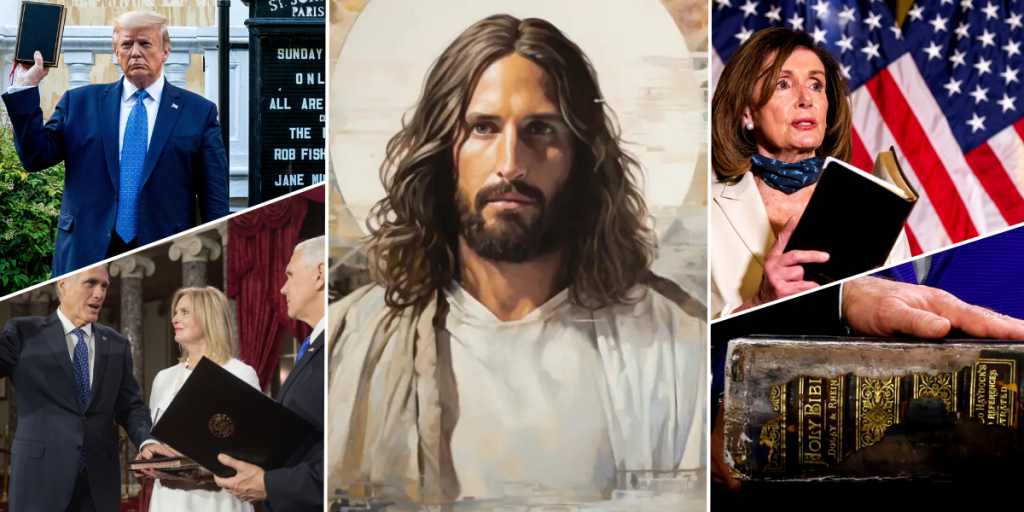
Typically, I try to stay away from commenting on politics and focus on theology. However, I read an article last year that I just can’t let go of; I felt like I needed to provide some sort of constructive response. In the Feb. 27, 2024 edition of the Princeton Clarion, there was an article written by Jim O’Donnell with Indiana Policy Review titled “Was Jesus Socialist Or Capitalist? It’s Complicated.”
His first statement is: “Some of our Lord’s harshest statements were about wealth and the rich.” He then sprinkled in a few observations about the economic structure found in the time of Christ. But ultimately, O’Donnell could not answer the question because Jesus just was not political, plain and simple. The religious leaders of Christ’s day certainly would have liked for Him to have been, and they painted Him as such regardless of the lack of evidence, but He just was not a political person.
The Jews of Christ’s day were looking for a political savior, one who would overturn the Roman occupation and set up a physical, earthly kingdom. The politicians of Christ’s day, the Pharisees and Sadducees included, couched their rhetoric in these terms, both openly and privately.
To understand their mindset at that time, you need to understand a bit about the Maccabees. Around 170 B.C., a Greek official tried to force a priest named Mattathias to make a sacrifice to a pagan god. The Jew murdered the man. In 167 B.C., the Jews rose up behind Mattathias and his five sons and fought for their liberation.
Like other rulers before him, the ruler at the time, Antiochus, underestimated the will and strength of his Jewish adversaries and sent a small force to put down the rebellion. When this force was annihilated, he led a more powerful army into battle only to be defeated again. In 164 B.C., Jerusalem was recaptured by the Maccabees and the Temple was purified. It took more than two decades of fighting before the Maccabees forced their adversaries to retreat from the land of Israel. In 142 B.C., after more than 500 years of subjugation, the Jews were again free.
When Mattathias died, the revolt was led by his sons. By the end of the war, Simon was the only one of the five sons of Mattathias to survive, and he ushered in an 80-year period of Jewish independence in Israel.
Ultimately, internal divisions and the appearance of yet another imperial power put an end to independence in Israel for nearly two centuries, as the Roman Empire captured Jerusalem in 63 B.C. So it was not long before the Advent of Christ that Israel was free, seemingly liberated by a savior who set up his kingdom on earth by crushing and ousting their oppressors. The air of anticipation was palpable; the anticipation for a messiah, a savior, was tangible. The Jews knew what the Scripture had to say about the coming Messiah.
The politicians of Christ’s day couched all of their rhetoric and promises in religious language. As it was in Jesus’ day, certain politicians today imbue religious rhetoric into everything they do and say. You may think that this would make me happy as a minister. Frankly, it doesn’t. The reason why is simple. Politicians have been using religion as a substitute for substantive thought and policy. Instead of providing sound ethical arguments for their case outside of Scripture, they use Scripture as a crutch. Politicians use it to defend their position on issues such as abortion, immigration, taxation, religious liberty, etc. While Scripture is certainly meant to guide us and help shape our worldview, it is not a substitute for sound reasoning and well-thought out arguments.
This practice is especially problematic considering that no politician represents a singular demographic. Politicians are elected to be a representative of their constituency, which means that they are representing far more than just Christians. I have no problem with a politician voting his or her conscience if it is in line with the overwhelming majority of their constituency. The problem comes when a politician votes against their constituents’ wishes due to their own personal religious views. Politicians are not voted into office to represent their religion; they are voted into office to represent their region.
So, why is this important theologically? At present, the political climate is toxic. Many people with more liberal political views think of conservatism and Christianity as being intertwined. They absolutely should not be—not because the values of conservatism are contrary to Christian thought but because religion and politics should not be mixed together. By mixing the two, the elected official runs the risk of alienating swathes of their constituency.
Politicians should run on their merits, not on their religion. Again I say, politicians are not voted into office to represent their religion, they are voted into office to represent their region. To represent their region correctly, they must be willing to vote in ways that go against how they would personally vote. Religion has a place in our nation’s history, iconography, and culture, but our politicians should be capable of politicking without invoking a deity.
The only person who has ever represented the whole of humanity on a single issue is Jesus regarding our sin—and still, He was no politician.
 T. Allen Burr Ministries
Leave a comment