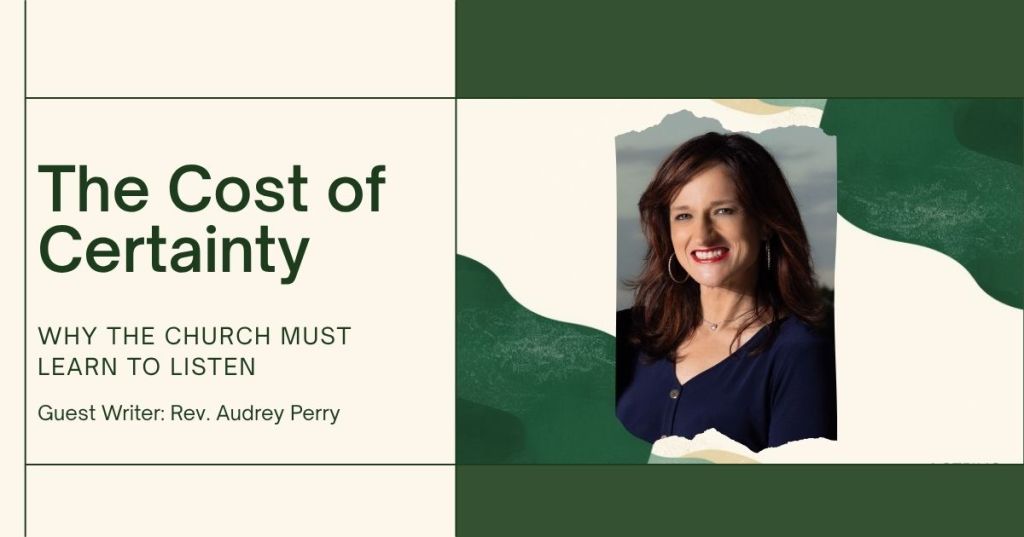
Submitted by Rev. Audrey Perry

While doomscrolling on Facebook, I saw comments on a local news article about a child acting out dangerously. Instead of the typical heckler remarks I expected to see, like “kids these days,” commenters actually came to the child’s and mother’s defense, showing familiarity and compassion. I sat in awe, witnessing the fruits of the autism awareness movement, which filled me with joy and a sense of solidarity.
Unity was the fruit of years invested in promoting resources for the autism community’s concerns, and their desire to be seen, heard, and understood.
Countless campaigns aim to raise awareness of issues such as cancer and other medical research, heart attack symptoms, domestic violence, human trafficking, and poverty. I used to wonder why raising awareness was so important to these groups. Why defend Black Lives Matter or respond with All Lives Matter as if promoting one group costs the other something? I make no excuses for my ignorance and white privilege; instead, I recognize my weaknesses and proactively seek understanding. A more challenging question we might ask is why more privileged individuals don’t.
The Dunning-Kruger effect explains this: it’s a psychological phenomenon where less skilled people overestimate their abilities, while more skilled individuals tend to underestimate theirs. The issue is that overconfident, less competent people believe they know everything they need to know, failing to recognize that they could improve. As a result, they are less inclined to reflect on their own thinking. Darwin was onto something when he noted, “Ignorance more frequently begets confidence than does knowledge.”
I hope my mention of Darwin doesn’t keep you from reading the rest of this article. Stay with me. An opportunity to become more Christlike exists on the other side of this offense if we can work past it. Why would she quote Darwin, of all people? In our culture, the divide between science and religion is incredibly significant.
Initially, many churchgoers rejected ideas that seemed to contradict biblical teachings. Over time, however, scholars have sought to reconcile theology with science, leading to revised biblical interpretations and more fruitful, culturally competent approaches to ministry.
Sadly, there’s still a lingering stigma associated with the scientific community, especially among more conservative and fundamentalist groups. Much of this comes from misunderstandings about psychological research on human needs and behavior. Maybe you’ve heard or even said some of these phrases:
- The Bible is all you need.
- Jesus is the answer to all your problems.
- You just need to pray harder/have more faith.
- Your PTSD/ADHD/ODD/OCD is a spiritual problem, not medical.
- You just need to stop dwelling on the past; forgive and move on.
- The Bible says to be anxious for nothing.
I admit I’ve said some of these phrases myself, trying to guide others back to the joy of the Lord from a heartfelt desire for truth, hoping to give them strength. Back then, this was the only way I saw things. My confidence in the Bible’s truth was founded solely on my own personal experience. I hadn’t considered how others may have experienced life differently. As a result, my use of the Scriptures did not lead others to life. Instead, my overconfident voice sounded like a loud gong and blended in with other self-righteous naysayers who were broadcasting their opinions in the comments section.
Before I had gone through situations in my life that demanded humility, such as chronic pain and foster parenting, my use of Scripture looked more like that of Job’s friends. Job told them that their counsel wasn’t just bad; it made his suffering worse.
My understanding of the Scriptures could also be compared to Peter’s use of the sword the night before Jesus was crucified. In his passionate zeal, he used his weapon to cut off a man’s ear only to have Jesus put it back on and heal him. Peter’s zeal could have cost another man his ability to hear the Lord’s voice. Have you ever noticed how different Peter seemed in Acts than in the Gospels? He was first humbled, then empowered by the Holy Spirit to embrace his weakness in humility.
If Peter had not let God use his failure to humble him, he probably wouldn’t have been able to love Jesus enough to truly care for and feed His sheep. I wonder how many people leave our churches hungry because we refuse to humble ourselves and put others’ needs before our own. Can you imagine the unity the body of Christ could have if we learned better ways to understand and support one another?
If we choose to ignore the cries of those advocating for trauma-informed practices in the church, I dare say we forfeit our ability to hear the voices of the very ones we are called to care for. Will we be a people who seek God’s truth and walk in wisdom? The truth usually begins by acknowledging that we don’t know what we don’t know, so we need to find out what we need to know and, in humility, embrace it!
How can we test the integrity of our love? We begin by examining ourselves. Then we get to know the people around us, listen to their stories, mourn with the mourners, and listen to the Holy Spirit so we respond with understanding rather than relying on our own interpretations. We begin in humility, accepting that we don’t fully understand how people experience trauma and how to minister to them. We believe what people tell us, acknowledging that everyone processes trauma differently.
We don’t need to fear evidence-based practices if we recognize that all truth is God’s truth. Studies have proven that there are better ways to help people. Now that we’re aware of this, it’s important that we take the time to thoughtfully consider them. Of course, we can choose to remain stagnant, ignorantly and pridefully overconfident in our own abilities, or we can grow to be more like Christ.
Stay tuned for Part II to learn more about trauma-informed pastoral counseling!
Rev. Audrey Perry is a credentialed minister with the Assemblies of God, a pastoral counselor, and writer devoted to helping the Body of Christ embody Christ’s love through genuine, trauma-informed care. She is currently completing her M.A. in Pastoral Counseling at Bridges Christian College Seminary, and she draws on nearly 20 years of experience as a home educator and former foster parent as part of her experience. Her love for the Lord and His people fuels her passion to equip churches with practical tools for integrating trauma-informed care, encouraging believers to lead with wisdom, empathy, humility, and grace. Her heart is to see every individual experience the embrace of God’s love—knowing they are truly seen, heard, and that they belong. To connect with Audrey for itinerant ministry opportunities or church training seminars, visit her website at www.audreywrites.com.


Leave a Reply